AI Strategy
How much does AI workflow automation cost in the UK? An honest answer
Any number quoted before someone has seen your process is a guess. Here is what actually decides AI workflow automation cost in the UK, and when to keep your money.
- Published
- Reading
- 7 min
- Chapters
- 05

Contents
Why nobody publishes an AI workflow automation cost in the UK
Ask five agencies what a project costs and you will get five variations of the same answer: “it depends, let’s book a call.” There is a reason the AI workflow automation cost UK buyers actually pay stays hidden until you are on a video call with someone reading a slide. Vague pricing lets the number flex to the room. It also filters out people who were never going to buy, which suits the seller and wastes everybody else’s morning.
It is tempting to answer that with a rate card. We will not, and the reason comes from watching how published prices behave in the real world. Eight years across UK property operations taught me the pattern: the maintenance job quoted “from” a number that quietly triples is the same trick as the software quote that only ever travels upwards from the teaser on a website. A “from” price is priced to the page, not to your process. It fits almost nobody, and it turns the first real conversation into a negotiation about why you are not average.
So this is the version of the pricing conversation we can honestly put in writing. Not a menu, because a menu would be a guess. What the money buys at each stage, the five levers that decide the figure, the payback sum that tells you whether any quote is worth paying, and the four situations where the right answer is to keep your money. Read it and the quote you eventually get, from us or from anyone else, should make sense line by line.
What the money actually buys
Automation work comes in three shapes, whoever builds it for you. A proof of concept is one workflow, built properly against your real data, so you can see it running before you commit to more. It answers a single question: does the idea survive contact with your actual inbox, rather than a demo built on tidy sample files?

A production build is a system you can lean on: several steps wired across the tools you already run, error handling, logging, and an approval step where a person still signs off the parts that matter. Managed and monitored is the ongoing piece. It covers the hosting, the watching, and the fixing when a supplier changes an API on a Tuesday with no warning.
Each shape carries a different weight of work, which is why we quote every project as a fixed figure after a short discovery call instead of publishing a number that pretends your business is average. A single form that drops a tidy record into one CRM sits at one end of the scale. A workflow that has to read messy human text, decide something, and touch three systems that were never designed to talk to each other sits at the other. Nothing about the figure is a surprise once you know which levers move it, which is the next part.
What moves the number
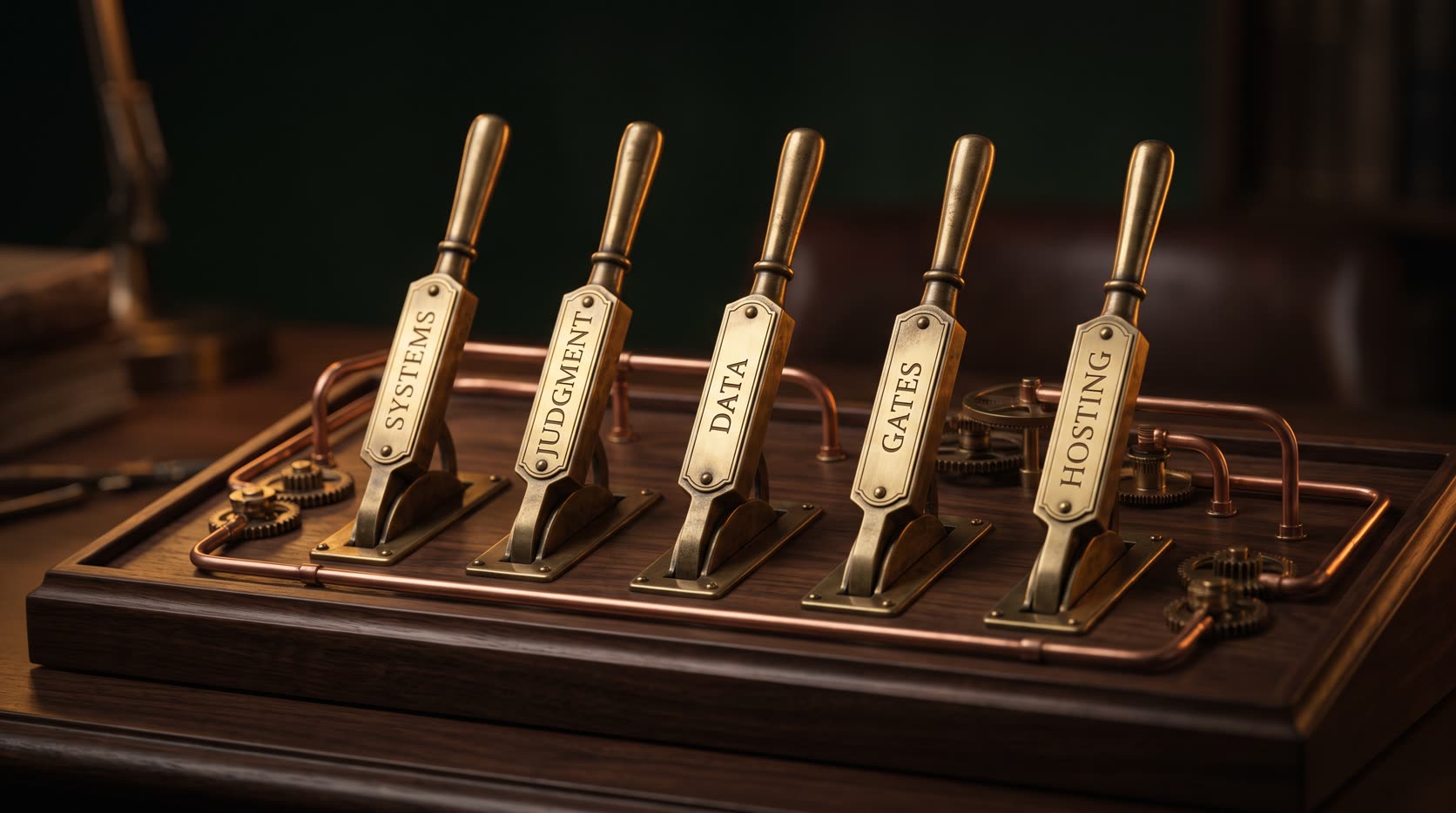
Five things, in plain terms.
First, systems touched. Automating one inbox is cheap. Automating an enquiry that has to land in your CRM, file a document in a shared drive, and raise a line in your accounting tool means four integrations, four sets of credentials, and four ways for something to break. Every hop adds build time and adds a thing to monitor.
Second, judgment depth. Filing a document by its type is close to free. Reading a tenant’s email, working out whether it is a repair, a complaint, or a notice, and routing it correctly is real work, because the automation has to be right often enough that a person trusts it without re-checking every case.
Third, data sensitivity. If a workflow handles personal data, tenant correspondence, or invoices, we design for retention, access, and what leaves your systems, which takes time we would rather spend once than apologise for later. The ICO’s AI and data protection risk toolkit is where that conversation starts, and it treats AI as a risk to assess rather than a shortcut around your obligations.
Fourth, human gates. An approval step, where the system prepares the work and a person presses send, costs design time. It is almost always worth it. The NCSC’s guidance on AI and cyber security makes the same point in security terms: accountability and a clear fallback matter as much as the clever bit in the middle.
Fifth, run and ownership. Who hosts it, who maintains it, and what “managed” actually includes. A workflow you own on infrastructure we watch is a different monthly number from a fragile script nobody has looked at since launch.
The payback question
Here is the sum, done honestly. Take the hours a week a task actually eats, multiply by the loaded cost of the person doing it (salary, on-costs, the lot), and compare that annual figure against the build plus a year of running it. If the maths is close, be sceptical. If it clears comfortably, move.
The trick people skip is measuring first. Before we build anything, we ask a client to log the real time a process takes for a fortnight, because memory rounds down and invoices do not. On one anonymised build, invoice triage for a UK clinic, the honest number was roughly four hours a week of bookkeeping admin: email polling, classification, filing into two document stores, and an audit log. That is the figure that paid for the project.
Four hours a week is around two hundred hours a year. Put your own loaded cost against that and set the result next to whatever quote you are holding, from us or from anyone else; the sum fits on the back of the invoice you are chasing. Measure it, do not assume it, and the AI workflow automation cost UK sceptics fear stops being a leap of faith and becomes arithmetic you can check yourself.
Two warnings on the sum. First, count the time the task really costs, not the time it is meant to take. A ten-minute job done fourteen times a day, interrupted, re-checked, and chased, is not ten minutes. Second, do not price in savings you cannot recover. If automating a task frees ninety minutes but that person has no better use for the ninety minutes, you have bought tidiness, not payback. The builds that earn their keep hand time back to work that was actually waiting for it: the viewing that went unbooked, the invoice that went unchased, the enquiry that sat unanswered while someone copied a name between two screens.
When you shouldn’t pay us
Four situations, and we say these on sales calls too.
If the process hardly ever runs, leave it manual. Automation earns its keep on repetition, and a rare task is cheaper to do by hand than to build, test, and maintain. If the rules keep changing, wait. A workflow encodes a decision, and encoding a decision that shifts every month means paying us to rebuild it every month. If your data is a mess, fix that first. We can automate around bad data, but we would be charging you to paper over a problem a spreadsheet clean-up solves for nothing. And if a decent off-the-shelf tool already does the job, buy the tool. Custom work is for the parts of your business that are genuinely yours, not for reinventing a calendar reminder.
None of that is false modesty. Turning down the wrong project is how we keep the right ones honest, and it is the same instinct that made us write this piece instead of a rate card. When the work does fit, the automation work these stages describe is exactly what we build: one process at a time, measured before and after, owned by you rather than rented back. Book a call and we will tell you, in the first thirty minutes, whether the number is worth paying. Sometimes the answer is no, and that is still the right answer.