Tools & Comparisons
AI knowledge base: 5 tests before choosing a model
AI knowledge base decisions need more than a demo. Use these 5 tests to judge policy summaries, SOP drafts and staff answers.
- Published
- Reading
- 9 min
- Chapters
- 04
Contents
AI knowledge base decisions: what operations and IT teams are really comparing
An AI knowledge base is a staff facing assistant that answers questions from approved company knowledge, such as policies, SOPs, onboarding packs, product notes and support documentation. For operations and IT teams, the decision is less about which model sounds most impressive and more about whether employees get trusted answers faster, with fewer tickets, fewer repeated questions and clearer accountability when the answer matters.
A long context assistant can read large documents or bundles of files in one session, which is useful for reviewing manuals, summarising complex procedures or comparing related policies. A GPT style connected assistant is often judged on how well it plugs into document stores, helpdesk tools, identity systems and workflows. Both approaches can work, but they solve different problems unless the surrounding design is right.
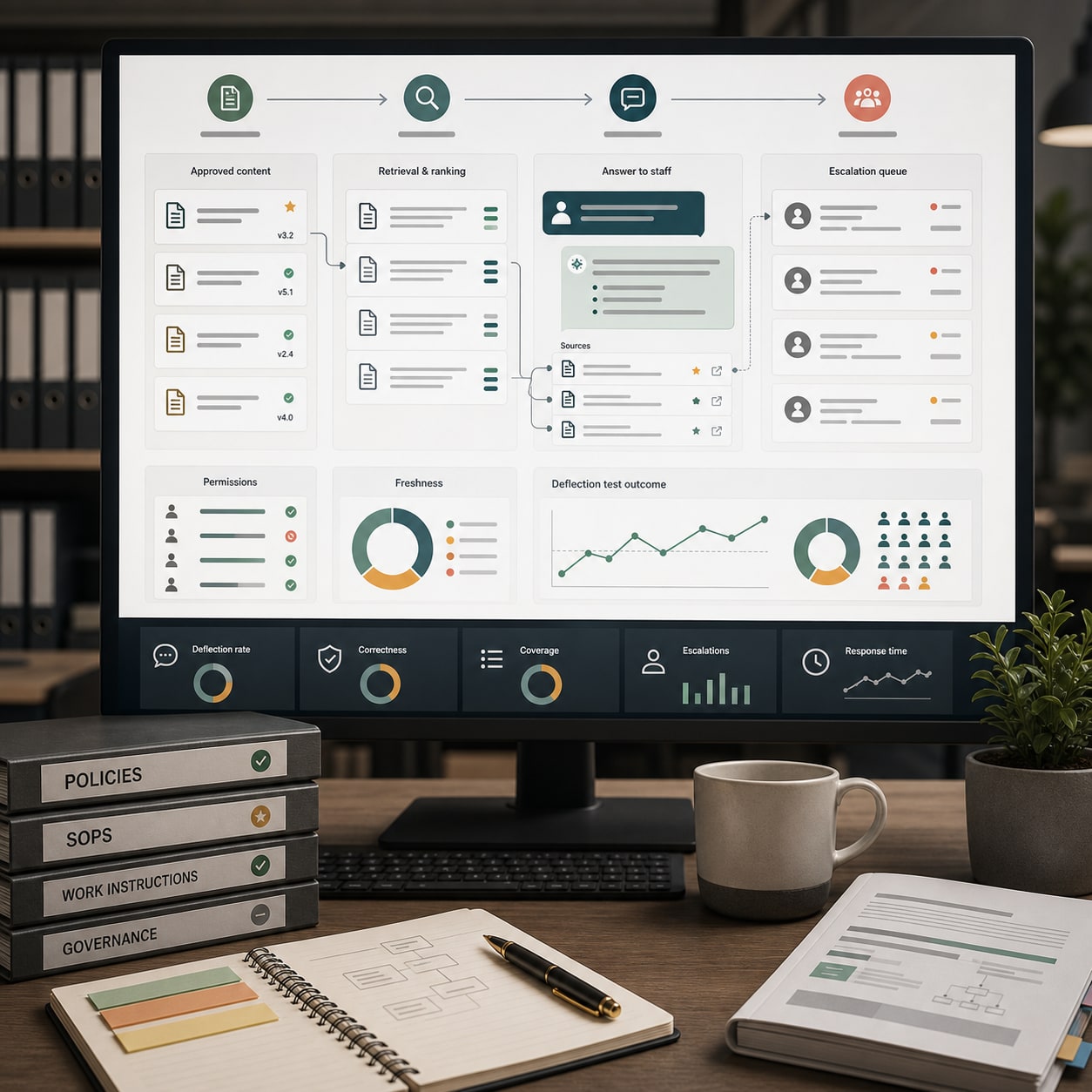
That is why the practical comparison should start with the Helpdesk Deflection Test. Take the questions HR, finance, IT and operations receive every week. Ask whether the assistant can answer them from the right source, show where the answer came from, respect access permissions and explain when it does not know. If it cannot pass that test, it is not yet AI helpdesk automation. It is just another place for employees to search.
Generic rankings are rarely enough for UK companies because the risk profile depends on your documents, users and governance. A public benchmark does not know whether a line manager should see a grievance template, whether a contractor can access a customer escalation note, or whether an answer about leave policy needs to reflect a recent internal change. The ICO guidance on AI is a useful reminder that accountability, transparency and data protection need to be designed in.
Document quality is often the hidden constraint. If policies contradict each other, SOPs are out of date, file names are vague and ownership is unclear, even a strong internal knowledge base AI will struggle. Retrieval design matters too. The system needs sensible chunking, metadata, source ranking, permission checks and review loops so that answers are accurate, traceable and limited to what the user is allowed to know.
The best employee support chatbot is therefore not simply the one with the longest context window or the most fluent tone. It is the one that reduces avoidable questions while staying accurate, permission aware and auditable. For Wise Solutions clients, that means comparing assistants by operational outcomes: fewer repetitive tickets, faster onboarding, cleaner policy access, better evidence trails and a governance model that IT and business leaders can actually maintain.
The Helpdesk Deflection Test for an internal AI knowledge base
A helpdesk deflection test asks a simple question: would you trust this assistant to answer the next fifty internal support tickets without creating new work for IT, HR, compliance or operations? A polished demo is not enough. An AI knowledge base has to deal with unclear policies, duplicated SOPs, old PDFs, local exceptions and staff who ask questions in their own words. The test should prove whether the system can reduce tickets while keeping answers traceable, permission aware and current.
Start with answer grounding. For every response, require the assistant to show which document, section and version it used. A RAG knowledge base should retrieve relevant passages before generating an answer, rather than relying only on general model memory. AWS describes retrieval augmented generation as a way to give a language model external context from internal documents, including search, retrieval and response generation. That is the right pattern for company policy and SOP content because the source material changes often.
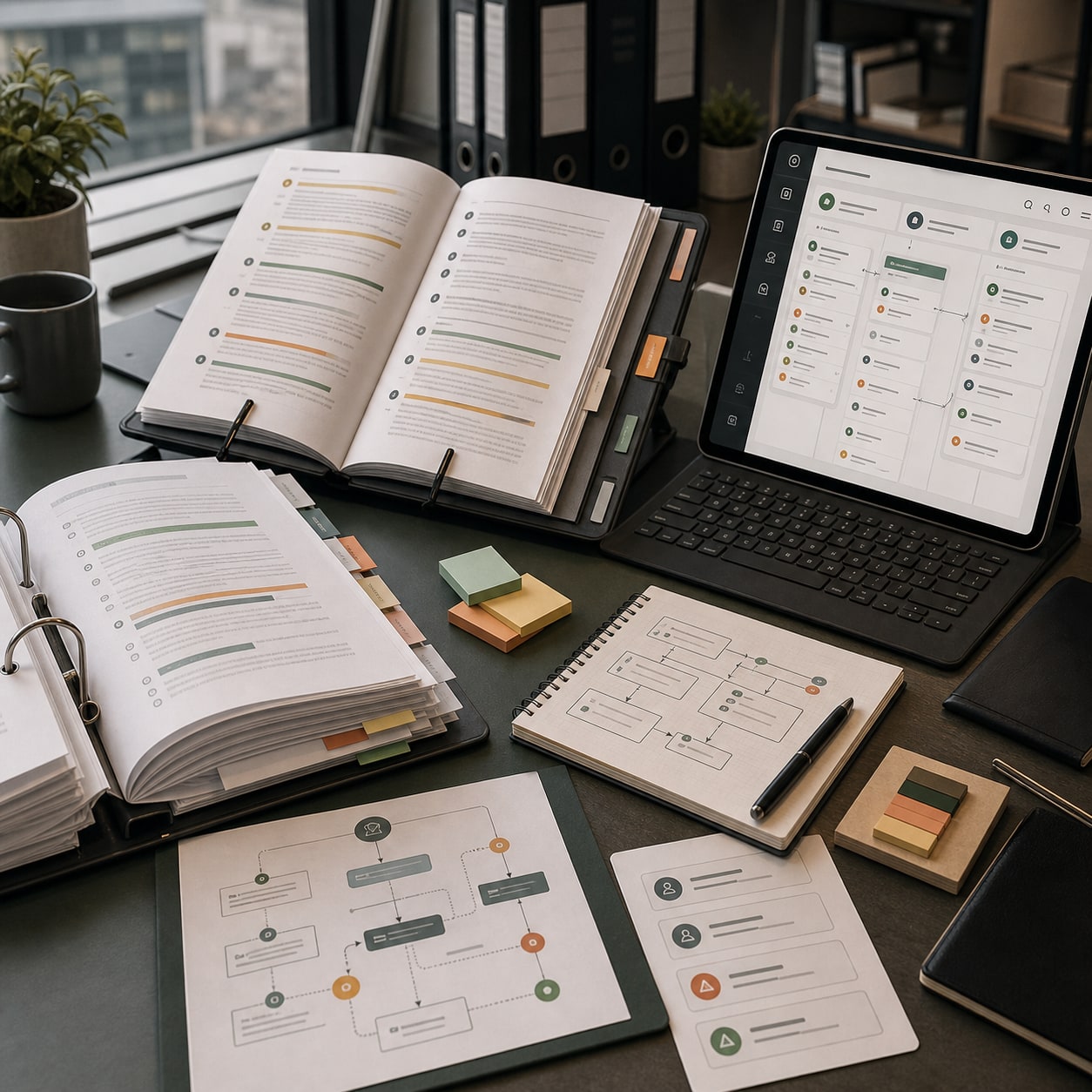
The first pass or fail check is citation quality. Ask questions where the correct answer sits in one paragraph, then in two conflicting documents, then in a table, then in an appendix. Good citations should point to the precise source, not just the file name. Weak systems cite whatever looks nearby. For AI policy summarisation, this matters because a confident summary of the wrong policy can be worse than no answer.
Next, test permissions. A secure AI knowledge base must respect the access a user already has. Finance staff should not see HR case notes because the assistant retrieved them. Managers should not receive wider results than their role allows. The evaluation should include users from different teams asking the same question, then checking whether answers and citations change correctly. Access control belongs in retrieval, not as a final cosmetic filter.
Security design should cover more than login. Check encryption, audit logs, retention settings, supplier access, data location, incident response and whether prompts or uploaded files are used to improve shared models. For UK organisations, personal data in staff handbooks, tickets and process notes can bring UK GDPR and Data Protection Act 2018 duties into scope. That means lawful basis, minimisation, transparency, security, retention and, where risk is high, a DPIA.
Freshness is the next major deflection risk. Many support tickets exist because policy changed and nobody trusts the old intranet page. The assistant should expose document age, owner, approval status and expiry date. It should refuse or caveat answers from obsolete material. For AI for SOPs, versioning is not administration, it is part of the answer. A good test includes retired SOPs and asks whether the assistant can avoid them.
Escalation rules should be explicit. The assistant should know when to say it cannot answer, when to ask a clarifying question and when to route the user to a human team. Test payroll, disciplinary, health and safety, security incident and legal hold scenarios. The best result is not always an answer. Sometimes deflection means collecting the right facts, linking the right form and sending a cleaner case to the helpdesk.
Measure the trial against real service outcomes. Useful metrics include ticket avoidance rate, answer acceptance, citation accuracy, permission failures, escalation accuracy, time to resolution and the number of corrections made by content owners. Include a human review sample, not just thumbs up feedback. Track whether the AI chatbot for internal documents is reducing repeat questions or simply moving confusion into a new interface.
Use messy real document tests before procurement. Load exported intranet pages, scanned PDFs, policy addenda, SharePoint copies, spreadsheets, old onboarding packs and regional variations. Ask frontline staff to write the questions, not the project team. Include spelling mistakes, abbreviations and incomplete context. A serious AI knowledge base should cope with the way employees actually ask for help.
A practical helpdesk deflection test can be run in two weeks. Choose twenty common ticket types, ten risky edge cases and ten deliberately awkward document problems. Score every answer for correctness, evidence, access control, freshness and escalation. Only deploy when the assistant passes the boring operational checks, because those are the checks that protect trust after the demo ends.
Long context assistant vs GPT style assistant for policies, SOPs and support docs
For policies, SOPs and support documents, the practical choice is less about which assistant sounds smarter and more about how the organisation expects work to happen. A long context assistant is useful when a person needs to review a large pack of related material in one sitting. It can compare a handbook, role specific SOPs, exception notes and recent updates, then explain where guidance is consistent, duplicated or unclear. That makes it a strong option for deep document review, drafting revisions and preparing compliance summaries.
The limit is that long context alone is not a managed AI knowledge base. If documents are uploaded ad hoc, the assistant may not know which version is approved, whether a policy has been superseded, or who is allowed to see a sensitive clause. It can read a lot, but governance still has to define source control, access rules, audit trails and review ownership. For regulated teams, NCSC secure AI system development principles can help frame those controls.
A GPT style assistant tends to fit better inside daily workflows. It can answer workplace chat questions, triage tickets, fill forms, create support macros, guide IT troubleshooting and trigger automation flows. In this model, the assistant is part of the operating system around work, not just a reader of documents. For example, an employee asking about annual leave can get an answer from HR policy, while a manager may be routed to an approval form or case note.
That convenience has its own risk. Polished answers can still be wrong if the assistant is not grounded in the right sources. A custom AI chatbot for internal documents should cite or expose the policy, SOP or ticket article behind the answer, especially for HR, IT and compliance topics. Without grounding, a confident reply about probation, laptop resets or data retention can create more work than it saves.
Use the long context approach when the task is analysis heavy: reviewing onboarding SOPs across departments, checking policy packs before publication, summarising audit evidence, or comparing regional support procedures. Use the GPT style approach when the task is action heavy: AI helpdesk automation, connected workplace assistant flows, ticket deflection, form completion and repeatable support macros.
A balanced operating model often uses both. The long context assistant supports expert review and document improvement. The workflow assistant serves employees at the point of need. The best AI chatbot for internal documents is therefore not defined by interface alone, but by ownership, permissions, retrieval quality, escalation paths and review cadence. For AI for SOPs, start with the workflow, then choose the assistant pattern that matches the risk and volume of the work.

Building secure internal knowledge that staff can trust
A trusted internal assistant starts long before any chat interface is built. The foundation is content readiness: current policies, procedures, templates, FAQs and operational playbooks that are accurate, readable and approved for staff use. Each source should have a named document owner, a review cadence and a visible version date, so teams know whether an answer reflects the latest position or an archived instruction. Without that discipline, even a well designed AI knowledge base can amplify confusion.
Retrieval design matters just as much as the model behind the assistant. Documents should be split into sensible sections, tagged with metadata such as department, audience, jurisdiction, sensitivity, owner and review date, then tested against real staff questions. Good metadata helps an internal knowledge base AI answer from the right source, refuse when it lacks enough evidence and route edge cases to the right person. It also gives managers a clear way to improve weak answers without rebuilding the whole system.
Security and compliance should be designed in from the start. Apply least privilege access, so staff only retrieve information they are already allowed to see. Define risk levels for different answer types, especially HR, legal, finance, safety and customer data. Build refusal and escalation paths for questions that require judgement, approval or a human decision. The NIST guidance on managing generative AI risk is a useful reference for organisations formalising governance.
The most practical route is to pilot with one department. Choose a team with repeated questions, stable documents and clear business metrics, such as faster onboarding, fewer internal support tickets, reduced search time, better policy compliance or improved first contact resolution in AI helpdesk automation. Track which answers are useful, which are refused, which need escalation and which documents cause uncertainty. A custom AI chatbot for internal documents should become more reliable with every review cycle, not remain a one time experiment.
Wise Solutions helps organisations turn this approach into a working service without expecting non technical teams to write code. We work with stakeholders to map content, define ownership, design metadata, plan access controls and measure outcomes. We can also help shape AI workflows and automation blueprints around the assistant, so knowledge retrieval connects with forms, approvals, ticket triage, reporting and staff support. The result is a secure document assistant that is practical, measurable and trusted by the people who use it every day.